
The fairytale palace
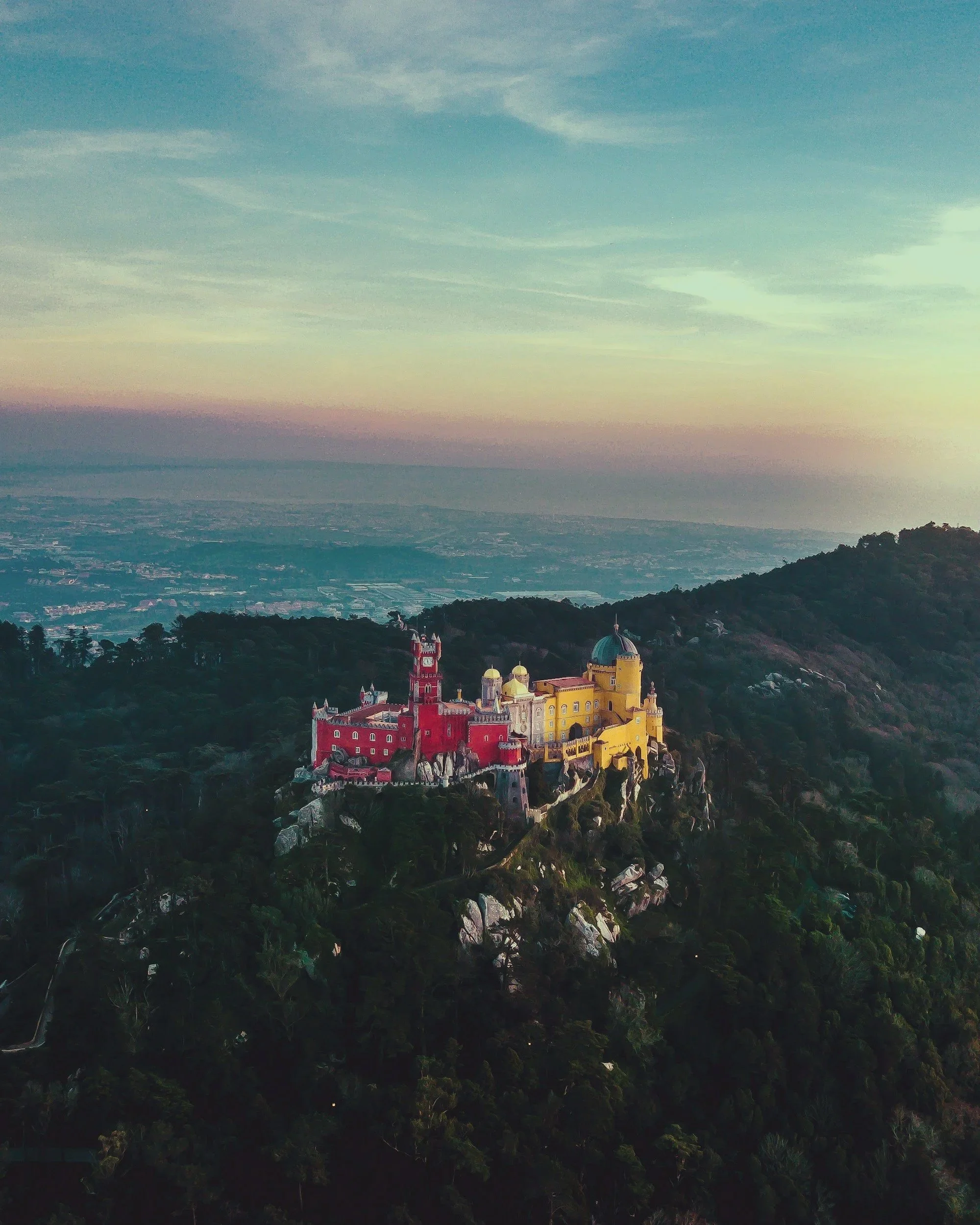
Sintra has a way of making you feel as though you have stepped into a different version of reality. The hills are impossibly green, the town looks like a film set, the air is cool and faintly misty even in summer, and perched at the very top of it all, visible from miles away, is the Palácio da Pena, painted in vivid yellow and red, with towers and turrets stacked against the sky. There is nothing quite like it in Europe, and it sits less than an hour from Ericeira. Sintra makes for one of the finest day trips from Ericeira, and Pena is the centrepiece of it.
A king with an imagination
The story of Pena begins with a ruin and a king. In the 1830s, King Ferdinand II, a German prince who had become King of Portugal by marriage, spotted the crumbling remains of a 16th-century Hieronymite monastery atop the Serra de Sintra and saw its potential. He bought the site and commissioned a fantastical palace around the monastery's bones, incorporating the original chapel (which still contains a breathtaking alabaster altarpiece from 1528) and cloister into a new building that piled Gothic arches next to Moorish domes next to Manueline stonework next to Renaissance towers - all of it painted in bold colours. By the time it was largely complete in 1847, he had created something that defied every architectural category. It is neo-Gothic, Islamic, Romantic, and medieval all at once - and somehow it all works beautifully.
The palace became the royal family's favourite summer residence, and much of the interior has remained almost exactly as it was when the last royals left in 1910, the same year King Manuel II departed from nearby Ericeira into exile. The kitchens still display the enormous copper pots used for royal banquets. The dining room retains its Manueline ceiling. The trompe-l'œil paintings in the sitting room still create their optical illusion of sculpted walls. It is one of the few royal palaces in Europe that feels genuinely lived-in rather than merely preserved.
What to see
There are two ways to visit: a park-only ticket gives you access to the 200-hectare forested grounds and the palace terraces, while the full ticket includes access to the state rooms. We strongly recommend the full ticket, the interior is quite spectacular.
Beyond the palace itself, the park is a lush, green paradise. Ferdinand II had trees brought from around the world; North American sequoias, Chinese ginkgos, Japanese cryptomeria, Australian tree ferns, etc., creating a dense, atmospheric forest. The Queen's Fern Garden is a particular highlight. Higher up, the Cruz Alta viewpoint (the highest point of the Serra de Sintra) offers views all the way to Lisbon and the sea on a clear day.
Don't miss the Chalet da Condessa d'Edla either, a charming alpine-style cottage built in 1869 for Ferdinand's second wife, a former opera singer, decorated throughout with cork in an extraordinary and completely unexpected way.
How to plan your visit
BOOK AHEAD (IF YOU WANT TO SEE THE INTERIOR)
There are two ticket options: the park ticket (€12) covers the grounds, terraces and Chalet da Condessa d'Edla and can be bought on the day. However, to enter the palace interior (€20), you need a timed slot booked in advance - these sell out quickly in high season, and there is no tolerance for late arrival. The best place to buy is the official website.
ALLOW A FULL DAY AND PLAN AHEAD
The quietest times are right at opening (9:30 am) and after 3:30 pm. The crowds that build up from 11 am onwards affect everything, as that's when the tour buses from Lisbon arrive and spread across the entire hilltop. If you want to visit in quieter times, plan the day carefully. Our tip would be - arrive in Sintra in the morning, explore the historic town centre, and enjoy an early lunch. Then take the 434 bus up in the early afternoon, it stops at the Moorish Castle on the way up, so hop off there first if you want to see it (more on that below) and walk the 10 minutes up to Pena afterwards. See the grounds first and then the interior, so book your palace interior slot for around 4 or 5 pm (5:30 is the last entry) when it's quieter. Also, afternoon light is quite beautiful - book earlier in the late summer/fall and later in the spring/early summer when the days are long. Weekdays are always calmer than weekends, and the shoulder seasons of April/May and October/November are quieter than summer.
GETTING THERE
From Ericeira, the easiest option is to drive to Sintra town centre, then take bus #434 up to the palace. You cannot drive directly to Pena. The station parking works well if you arrive early. During summer (June to the end of August), the train station parking lot may already be full or involve long queues in traffic by the time you arrive, so in peak season, you need to be there early, before 9 am.
THE BUS
Bus 434 departs from outside the train station in Sintra - you'll see buses lined up outside, parallel to the train tracks. It’s a hop-on, hop-off route with multiple stops. The full route is: Sintra Estação → São Pedro de Sintra → Largo Ferreira Castro (historic centre) → Castelo dos Mouros → Palácio da Pena → Sintra Vila → Sintra Estação. Tickets can be bought at the bus stop opposite the tourist office. If you’re in the old town already, catch the bus at Largo Ferreira Castro.
CASTELO DOS MOUROS
Due to the narrow one-way roads, on the return journey, the bus does not stop at the Moorish Castle; it goes straight down to Sintra Vila and back to the station. So if you plan to visit both, the advice is to get off at the Moorish Castle on the way up and walk the 10 minutes to Pena from there. Unlike the Pena Palace, the Moorish Castle has no timed entry, but it requires a separate ticket and about 45 minutes to visit.
WEAR GOOD SHOES
The paths through the park are steep and cobbled. Comfortable walking shoes are essential; this is not the place for flip-flops.
Unsplash
O palácio de conto de fadas
Sintra tem uma forma de nos fazer sentir como se tivéssemos entrado numa versão diferente da realidade. As colinas são incrivelmente verdes, a vila parece um cenário de filme, o ar é fresco e ligeiramente enevoado mesmo no verão, e no topo de tudo, visível a quilómetros de distância, ergue-se o Palácio da Pena, pintado em amarelo e vermelho vibrantes, com torres e torreões recortados contra o céu. Não há nada semelhante na Europa, e fica a menos de uma hora da Ericeira. Sintra é um dos melhores passeios de um dia a partir da Ericeira, e o Palácio da Pena é o seu grande destaque.
Um rei com imaginação
A história do Palácio da Pena começa com uma ruína e um rei. Na década de 1830, o rei Fernando II de Portugal, um príncipe alemão que se tornou rei de Portugal por casamento, encontrou as ruínas de um mosteiro jerónimo do século XVI no topo da Serra de Sintra e percebeu o seu potencial. Comprou o local e mandou construir um palácio fantasioso em torno da estrutura original, incorporando a capela (que ainda hoje guarda um impressionante retábulo de alabastro de 1528) e o claustro num novo edifício que mistura arcos góticos, cúpulas mouriscas, elementos manuelinos e torres renascentistas, tudo pintado com cores intensas. Quando ficou praticamente concluído em 1847, tinha criado algo que desafia qualquer categoria arquitetónica. É neogótico, islâmico, romântico e medieval ao mesmo tempo — e, de alguma forma, funciona de forma harmoniosa.
O palácio tornou-se a residência de verão preferida da família real, e grande parte do interior permanece quase exatamente como estava quando a monarquia deixou o país em 1910, o mesmo ano em que o rei Manuel II de Portugal partiu para o exílio a partir da vizinha Ericeira. As cozinhas ainda exibem os enormes tachos de cobre usados em banquetes reais. A sala de jantar conserva o seu teto manuelino. As pinturas em trompe-l'œil na sala de estar continuam a criar a ilusão de paredes esculpidas. É um dos poucos palácios reais na Europa que parecem verdadeiramente habitados, e não apenas preservados.
O que ver
Há duas formas de visitar: um bilhete apenas para o parque dá acesso aos 200 hectares de jardins florestais e aos terraços do palácio, enquanto o bilhete completo inclui o acesso às salas interiores. Recomendamos vivamente o bilhete completo, o interior é verdadeiramente impressionante.
Para além do palácio, o parque é um paraíso verde e exuberante. Fernando II mandou trazer árvores de todo o mundo, sequoias norte-americanas, ginkgos chineses, criptomérias japonesas, fetos arbóreos australianos, entre outras, criando uma floresta densa e atmosférica. O Jardim das Fetos da Rainha é um dos pontos altos. Mais acima, o miradouro da Cruz Alta (o ponto mais elevado da Serra de Sintra) oferece vistas que, em dias limpos, chegam até Lisboa e ao mar.
Não deixe de visitar o Chalet da Condessa d’Edla, uma encantadora casa de estilo alpino construída em 1869 para a segunda mulher de Fernando, uma antiga cantora de ópera, decorada de forma surpreendente com cortiça em todo o seu interior.
Como planear a sua visita
RESERVE COM ANTECEDÊNCIA (SE QUISER VISITAR O INTERIOR)
Existem duas opções de bilhete: o bilhete do parque (12 €) inclui os jardins, terraços e o Chalet da Condessa d’Edla e pode ser comprado no próprio dia. No entanto, para entrar no interior do palácio (20 €), é necessário reservar um horário com antecedência, estes esgotam rapidamente na época alta e não há tolerância para atrasos. O melhor é comprar no site oficial.
RESERVE UM DIA INTEIRO E PLANEIE COM CUIDADO
Os períodos mais tranquilos são logo à abertura (9h30) e depois das 15h30. A partir das 11h, as multidões aumentam significativamente, com a chegada dos autocarros turísticos de Lisboa. Se quiser evitar maior afluência, planeie bem o dia. A nossa sugestão: chegue a Sintra de manhã, explore o centro histórico e almoce cedo. Depois apanhe o autocarro 434 no início da tarde, este passa pelo Castelo dos Mouros, onde pode sair primeiro, visitar e depois caminhar cerca de 10 minutos até ao Palácio da Pena. Visite primeiro os jardins e depois o interior, marcando a entrada no palácio para as 16h ou 17h (a última entrada é às 17h30), quando está mais calmo. A luz da tarde também é especialmente bonita. Durante a semana há menos pessoas do que ao fim de semana, e os meses de abril/maio e outubro/novembro são mais tranquilos do que o verão.
COMO CHEGAR
A partir da Ericeira, a forma mais simples é conduzir até ao centro de Sintra e depois apanhar o autocarro 434 até ao palácio. Não é possível ir de carro diretamente até ao Palácio da Pena. O estacionamento junto à estação costuma funcionar bem se chegar cedo. No verão (junho a agosto), o parque pode encher rapidamente ou implicar longas filas, por isso convém chegar antes das 9h.
O AUTOCARRO
O autocarro 434 parte em frente à estação de comboios de Sintra. É uma linha “hop-on hop-off” com várias paragens: Sintra Estação → São Pedro de Sintra → Largo Ferreira Castro (centro histórico) → Castelo dos Mouros → Palácio da Pena → Sintra Vila → Sintra Estação. Os bilhetes podem ser comprados na paragem em frente ao posto de turismo. Se já estiver no centro histórico, pode apanhar o autocarro no Largo Ferreira Castro.
CASTELO DOS MOUROS
Devido às estradas estreitas e de sentido único, no regresso o autocarro não para no Castelo dos Mouros, seguindo diretamente para a vila de Sintra e depois para a estação. Por isso, se quiser visitar ambos, o ideal é sair no Castelo dos Mouros na subida e caminhar até ao Palácio da Pena. Ao contrário do Palácio da Pena, o castelo não tem horário marcado de entrada, mas requer um bilhete separado e cerca de 45 minutos para a visita.
CALÇADO ADEQUADO
Os caminhos no parque são íngremes e empedrados. É essencial usar calçado confortável e apropriado para caminhar, este não é um local para chinelos.